

You have been publishing. Maybe not every week, but consistently enough that there is real content on your site. Articles that look relevant, cover the right topics, and read well enough. Traffic stays flat. Rankings barely move. The new posts go live, Google crawls them, and nothing much changes. The natural response is to publish more. That is usually the wrong move, and this article explains why writing more blog posts won’t fix Google rankings when the underlying problem is something else entirely.
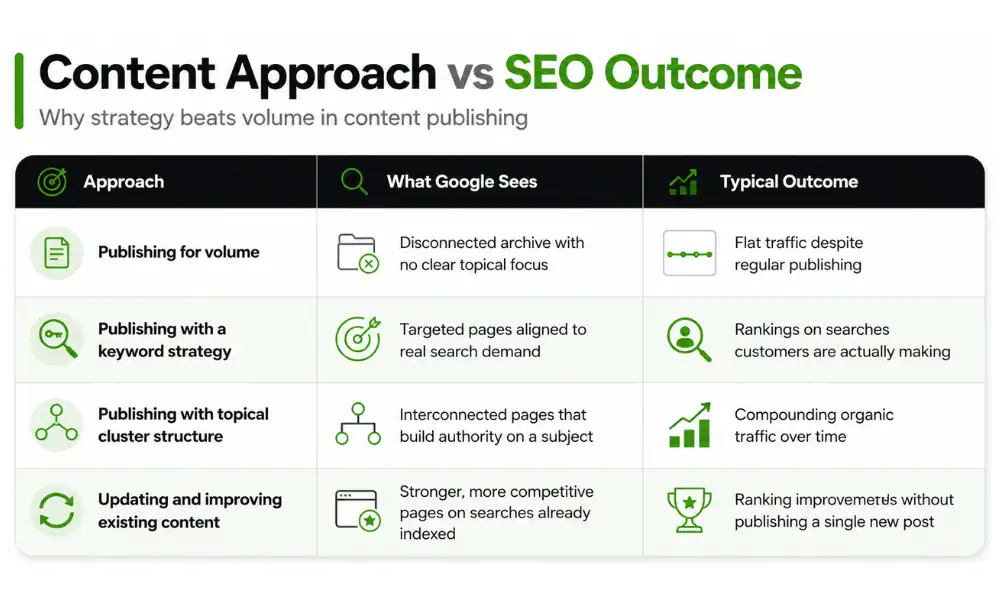
Writing more blog posts won’t fix your Google rankings when the content lacks a clear strategic role. Most businesses that struggle with flat organic traffic share the same core problem: the articles they are publishing are not built around what their customers are actually searching for, they are not connected to each other in a way Google can follow, and they do not have a clear relationship to the services the business sells. More posts do not solve any of those problems. They add more content to an already-unfocused archive.
Volume Is Not a Ranking Signal
Search engines are not counting your posts and rewarding you for reaching a certain number. Google is trying to understand what your website is about, which pages are genuinely useful, and whether the content matches the intent behind a real search query. A website can have four hundred blog posts and rank for almost nothing. Another site with thirty well-targeted, strategically connected articles can outperform it across dozens of competitive keywords.
Businesses that publish often and still see no movement are usually dealing with at least one of these problems: the topics do not match real search demand, the pages are too disconnected to build any topical depth, or the content is not structured in a way that helps Google understand what it should rank. Publishing more articles into that situation dilutes the signal further. Search Engine Journal’s breakdown of how Google evaluates authority across a site makes clear why depth and structure matter far more than post count.
Your Content May Be Targeting Topics Nobody Is Searching For
One of the most common reasons a blog goes nowhere despite regular publishing is that the articles are written around topics rather than search intent. A topic can feel completely relevant to your business without matching what your target customers actually type into Google.
There is also a real difference between someone researching a problem for the first time and someone comparing service options before making a decision. Content that does not account for that difference attracts the wrong visitors, or no visitors at all, regardless of how often it is published. It is also one of the main reasons businesses end up getting traffic but no clients from it. When the content being published does not match what customers are searching for, that mismatch does not get better with more posts. It compounds. Every article added to an already misaligned archive is another page that earns no traffic and builds no trust with Google.
Unfocused Publishing Does Not Build Topical Authority
One month a business publishes about SEO. The next is about social media. Then email marketing. Each topic might feel relevant to the industry, but together they do not tell Google that this website has real depth on any one subject.
Google looks for topical authority when deciding which sites to trust with rankings on competitive terms. A website that covers ten subjects at a surface level competes weakly against a site that covers two subjects in real depth. Depth means having a main article on a subject supported by related articles that go into the specific questions your audience is searching for. Those articles link to each other and back to a central piece, and Google can map the relationship between them. Without that structure, every new article published is essentially invisible to the system it needs to work within. Search engines cannot map what a disorganised archive is about, and they do not rank sites they cannot categorise. For a closer look at what happens when content lacks that structure, see our guide on why your business content isn’t ranking on Google.
New Content Is Not Always Where the Money Should Go
A lot of businesses spend their entire content budget on new articles while ignoring pages that are already close to performing. Some posts may already appear in search results but sit in positions eight through fifteen, generating almost no clicks. Others might have outdated information or thin sections that are holding them back from competing with stronger pages.
In those cases, a page that already has some traction is much closer to ranking than a brand-new article starting from zero. Businesses that ignore this leave rankings on the table they had already earned the right to compete for. A published blog post is not finished when it goes live. Treating it as though it is, and moving straight to the next new topic, is one of the quieter ways a content budget gets spent without producing results.
Content Overlap Is a Side Effect of Publishing Without a Plan
When a business publishes often without a clear structure, it eventually ends up with multiple articles competing for the same search. Three articles with slightly different titles but nearly identical keyword focus do not multiply ranking potential. They split it. Each page gets some of the signals that should be concentrated in one authoritative resource, and none of them rank as well as a single well-built article would.
This is called keyword cannibalization, and it is a direct side effect of publishing for volume. The fix is not more content. The fix is consolidating the weaker versions and building up the one that should own the topic. Writing another article on the same subject before doing that work makes the problem worse.
Digital Ranking Solutions works with businesses that have been publishing consistently and still are not seeing meaningful organic growth. The problem is almost never a lack of content. It is usually that the articles were built without a clear picture of which searches matter, how the articles connect to each other, which pages are already close to ranking, and whether the blog is pointing people toward the services the business sells. That is the kind of review that has to happen before more publishing makes sense. For businesses ready to stop adding to an unfocused archive and start building content that actually ranks, it is where that process begins. More at digitalrankingsolutions.com.
What to Think About Before Publishing Anything Else
Publishing blog posts can absolutely help with organic visibility. The issue is publishing without a plan. If your website already has dozens of articles and traffic is still flat, the solution is probably not another batch of posts. The real problem could be the topics being targeted, the way existing content is structured, a lack of internal connections between articles, pages competing against each other for the same keyword, or content that never leads a reader toward your actual services. Most businesses that have been publishing for months or years without results do not have a publishing problem. They have a strategy problem that more publishing cannot solve on its own. If the bigger picture of why content fails to bring in clients is what you are trying to understand, our full breakdown of content strategy that connects to the services you sell covers the whole problem in depth.
If your content is not bringing in the clients it should be, the strategy behind it is worth a closer look. Contact Digital Ranking Solutions today to find out what a content approach built around your actual customers and services could do for your organic visibility.