

Your content is showing up. People are clicking through. The analytics confirm it: sessions are ticking up, pages are being read, and Google has clearly taken notice. So why is nobody getting in touch? If your SEO content gets clicks but produces no enquiries, the instinct is to assume something is wrong with your offer, your pricing, or your website design. Most of the time, the problem starts much earlier than that, before the visitor ever lands on the page.
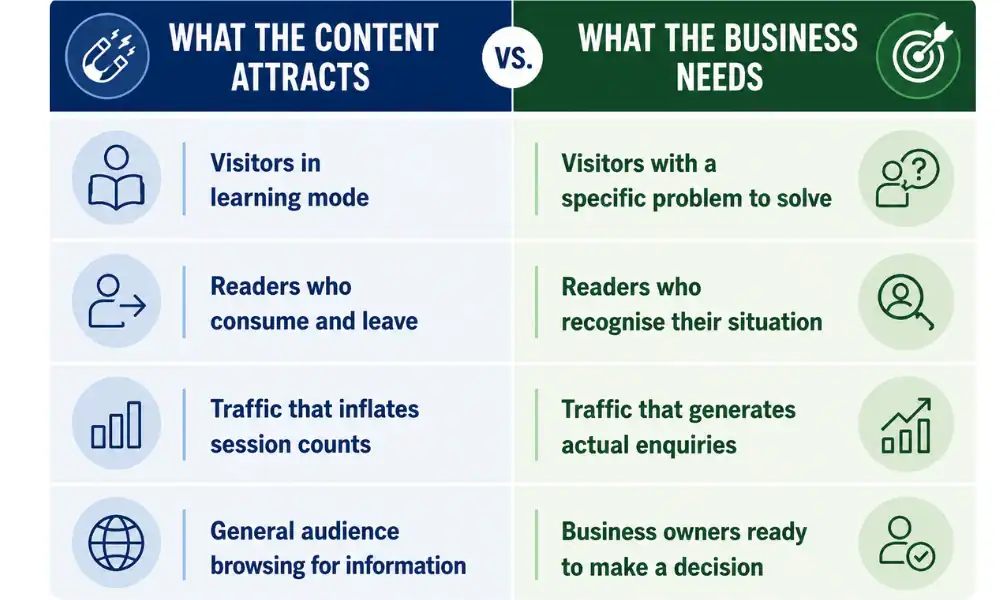
When SEO content gets clicks but no enquiries, it usually means the content is attracting the wrong type of visitor. The article ranks, but for a search that people in research or learning mode make, not people who are ready to hire. Traffic numbers look fine. Enquiries do not come.
What Clicks Actually Tell You (And What They Do Not)
Clicks are a measure of relevance to a search, not relevance to your business. When someone searches a phrase and your article appears, the click means your title and description matched what they were looking for. It does not mean they are a potential client. That distinction matters more than most business owners realise when they start reviewing their content performance.
The type of person clicking through is determined almost entirely by the search phrase the article targets. A post written around a broad, educational question draws readers who want to learn something. A post written around a specific, problem-driven phrase draws readers who are frustrated and looking for someone to help. These are very different visitors, and they behave differently once they land.
A business owner who clicked to understand how SEO works will read the article and leave. A business owner who clicked because they are watching a competitor outrank them and losing clients over it will read the article, recognise their situation, and wonder who they can talk to. The content that generates enquiries is written for the second person.
The Gap Between Traffic and Enquiries in SEO Content
The most common reason SEO content produces traffic without enquiries is a mismatch between the search intent behind the keyword and where that visitor is in the buying decision. Search Engine Land’s coverage of search intent identifies this as one of the most consistently misunderstood problems in content strategy: businesses rank for terms that attract an audience, but not the right audience.
A business publishing articles around general concepts or broad how-to topics will build traffic over time. Google rewards that content because people search for it. But those visitors are in information-gathering mode. They are reading, comparing, and learning, and they will close the tab when they are done.
The businesses that see enquiries from content are targeting searches that reflect a different mental state. Those searches carry commercial weight. The person behind them already has a specific problem and is looking for who to trust with it. When content speaks to that frustration and describes the cost of leaving it unresolved, those visitors respond differently. They reach out.
Why the Right Keyword Is Not Enough on Its Own
Getting the keyword right is a starting point, not a guarantee. Even when a business targets a commercially relevant phrase, the way the content is written determines whether it connects with someone ready to enquire or simply gives them enough information to walk away satisfied.
Content that explains too much creates readers, not clients. When an article walks through a problem and lays out how it gets resolved, the reader gets what they came for and leaves. There is no gap for them to feel, no unresolved tension that makes them pick up the phone.
Content that names the problem, describes its cost, and makes the professional gap visible: that is what shifts a reader’s thinking from “now I understand” to “I need to sort this out.” Google Search Central’s guidance on helpful content draws a clear line between content that satisfies a query and content that actually serves the person behind it. The businesses whose content generates enquiries understand that distinction.
What the Enquiry Gap Actually Costs
A website generating consistent traffic with no enquiries is not a neutral situation. Every visitor who clicked through and left without contact was, in some cases, a potential client. They had a problem, they found the site, and something in the content did not connect them to the business as the solution. That person did not disappear. They found a competitor whose content was built with a clearer understanding of who it was for.
This is not a traffic problem. Fixing it does not mean publishing more or targeting higher-volume keywords. It means the content strategy needs to be built around a different kind of visitor from the start.
When Clicks Are Not the Right Metric to Watch
Traffic numbers do not tell you whether the people arriving are ever going to become clients. A post with five hundred monthly visitors and three enquiries is performing well. A post with five thousand visitors and no enquiries has something structurally wrong with the content or the keyword behind it.
Businesses that treat traffic as the goal end up writing for it. Content piles up, sessions accumulate, and the contact form stays quiet. The volume looks fine in reports. The business is not growing.
Enquiries are the signal that the content strategy is working. Everything else is context. When enquiries are absent despite traffic being present, the content is solving the wrong problem for the wrong person.
Digital Ranking Solutions works with businesses that are producing content and not seeing the commercial results they expected from it. Their SEO content writing service is built around identifying the right search intent for each piece: the specific stage of the buyer journey, the exact frustration the target client is feeling, and the way to position the business as the answer without handing the reader a roadmap to go it alone. For businesses where the traffic is there but the enquiries are not, it is worth understanding why the gap exists before producing more content into it. More at digitalrankingsolutions.com.
What the Traffic Is Telling You
Clicks without enquiries are a signal, not a failure. They confirm the content is visible. The problem is that it is pointed at the wrong person. The keywords, the angle, the framing, all of it attracted a reader who was never going to reach out.
Understanding the difference between content that ranks and content that brings in clients is where the fix starts.
If your content is generating traffic but the enquiries are not following, the strategy behind that content is worth a closer look. Contact Digital Ranking Solutions today to find out what a content approach built around your actual buyers, not just your search volume, could do for your organic visibility.