
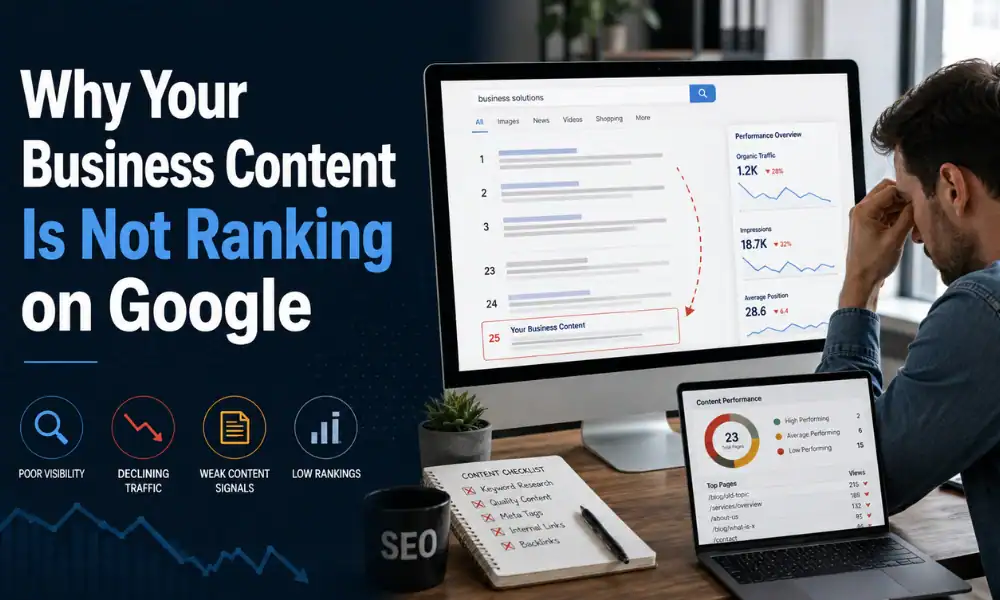
Business content not ranking is one of the most frustrating problems a business owner can run into. You have been publishing consistently, watching the posts pile up in the blog, timestamped, covering topics that felt relevant when you wrote them. And when you search Google for anything related to what you do, your content is nowhere.
Business content fails to rank when it targets keywords that are too competitive, covers topics without a focused structure, or mismatches the intent behind what buyers actually search for. Publishing more of the same content does not fix these problems. The issue is strategic, not cosmetic, and the longer it goes unaddressed, the more it costs.
Business Content Not Ranking Usually Means the Keywords Are Wrong
Google does not rank content based on effort or consistency alone. It ranks content that matches what a specific person is searching for, at a specific stage of their decision-making, from a site it trusts on that subject. When content falls short on any of those points, it does not matter how well-written the posts are.
The keyword problem is usually the first place to look. A relatively new or mid-authority blog targeting terms like “content marketing” or “SEO tips” is competing against sites with years of domain authority and thousands of inbound links. That competition is not winnable in the short term, and publishing more posts targeting the same broad terms will not change the math.
As Search Engine Journal has documented in its analysis of why content fails to rank, relevance and specificity are stronger indicators of ranking potential than search volume alone. A narrower term matched to a site’s actual authority is where organic traction starts. Broad terms often look appealing in a keyword tool, but they keep content stuck at the bottom of search results indefinitely.
What Happens When Content Covers the Wrong Intent
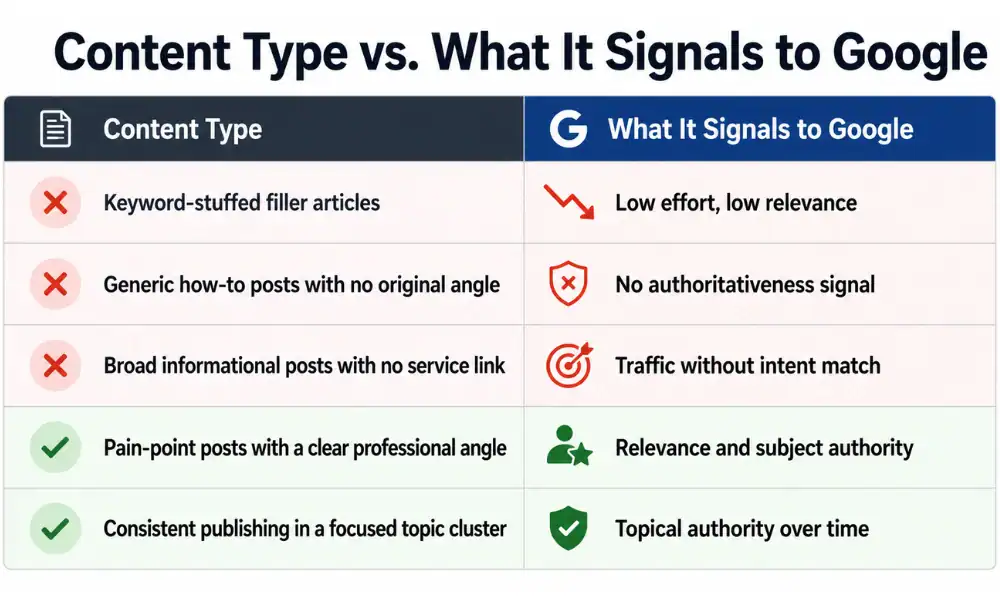
Beyond keywords, there is the question of intent. Google classifies every search by what the person behind it is actually trying to do. Some searches are informational, some navigational, and some signal that a person is close to a buying decision. The content that generates business tends to match that third category.
When a business blog is built primarily around general, educational topics, it attracts readers who are learning, not buying. Businesses expect those readers to convert into clients, and that conversion rarely happens at scale. A reader who came looking for general information leaves once they have it. They were not in a buying mindset when they arrived.
The cost of this pattern is not obvious at first because the traffic numbers look real. Visitors are coming, pages are being read, the analytics show activity. What the analytics do not show is whether any of those visitors were in a position to hire the business, and in most cases, they were not.
This is the same gap covered in the full breakdown of why business content fails to bring in clients, where the gap between reach and demand determines whether a blog turns into a source of business.
The Structural Problem That Keeps Business Content From Building Authority
Google’s approach to topic authority has changed how it evaluates blog posts. A single article carries less weight in isolation from related content, and Google looks for signals that a site covers a subject with real depth before promoting any piece to competitive rankings.
This is the structural problem most business blogs run into. Posts get published one at a time, without a connecting framework. There is no pillar page anchoring the subject, no cluster articles building out related angles, and no internal links giving Google a map of how the content connects. Each post gets evaluated alone, without the benefit of the topical authority the site might have built otherwise.
Search Engine Land’s analysis of why content fails to appear in AI Overviews even when it ranks found that structural clarity is one of the primary factors separating content that gets cited from content that gets skipped, even when both pieces target similar terms. A blog full of isolated posts gives Google nothing to build a picture of subject authority on.
What Business Content Not Ranking Is Actually Costing You
This is the part that tends to get underweighted. Every article has a cost, whether that is time spent writing it or money paid to a writer. When that investment does not produce rankings or leads, it is not just money spent without a return, it is time a competitor is using to grow.
This shows up in a related form when content does rank but still fails to convert. The reasons why your blog gets traffic but no clients overlap closely with the ranking problem, and businesses dealing with one often run into the other.
There is also a cumulative effect on how business owners view content marketing. Businesses publishing for six months or a year without results often conclude that blogging does not work for their industry. That conclusion is understandable, but it is wrong. Content marketing produces results when built around the right keywords, intent, and structure.
The businesses that generate consistent organic traffic made specific decisions about topic focus, keyword targeting, and internal architecture. Those decisions are not visible to a reader. What is visible is that the content ranks and the inquiries follow. Getting to that position means treating content as a strategy problem, not a scheduling problem.
Why Getting This Right Requires More Than a New Topic List
Digital Ranking Solutions does exactly this kind of work. Their SEO content writing service covers keyword research, topic architecture, and full article production, built around the intent and authority level that gives each piece the best chance to rank. For businesses publishing without a clear content strategy, it is a way to change direction. More at digitalrankingsolutions.com.
The Gap Between Publishing and Ranking Is a Strategy Gap
Business content that is not ranking is almost never a quality problem in isolation. The issue is whether the content was built to rank in the first place: whether the keywords were winnable, whether the intent matched what buyers actually search for, and whether the site’s internal structure gives Google something coherent to evaluate.
Businesses that close that gap stop treating their blog as a publishing obligation and start treating it as the top of their client acquisition funnel. The ones that do not keep spending time and money on content that generates activity without generating business.
If your business content is not ranking after months of publishing, the strategy is the problem, not the posts. Contact Digital Ranking Solutions today for SEO content built around the keywords and structure that give your site a real chance to rank.