

You can see people are landing on your site. The analytics show visitors coming in, posts getting read, pages loading. And your phone is not ringing and your inbox is quiet. If your blog produces traffic but no clients, the problem is not the blog itself. The issue is what the blog is doing, and more precisely, what it is not doing.
Blog traffic that does not convert into clients usually means the content is attracting the wrong audience, answering questions that have nothing to do with buying decisions, or failing to give readers a reason to take the next step. Getting visits is not the same as generating demand, and most business blogs confuse the two.
Blog Traffic and Client Inquiries Are Two Different Things
Visitor counts do not equal leads. This is a gap that catches a lot of business owners off guard, because traffic feels like proof that something is working. The blog is getting read. People are finding the site. That should mean business is coming, right?
What traffic actually measures is reach. It tells you that a piece of content showed up somewhere in search results and someone clicked on it. What it does not tell you is whether that person had any interest in buying what you sell, or whether they were anywhere near a purchasing decision when they arrived.
A post that ranks for a broad question might pull in thousands of visitors who are curious, doing research, or looking for free information. That kind of traffic fills a dashboard and flatlines a sales pipeline. The visits look real because they are real. The problem is who those visitors are and why they came. It is the same pattern explored in the full breakdown of why business content fails to bring in clients — traffic and leads are two separate outcomes, and the content strategy determines which one you get.
The Content Most Business Blogs Publish Is Not Targeting Buyers
Most business blog content targets questions, not decisions. There is a difference, and it matters enormously to whether a visitor turns into a lead.
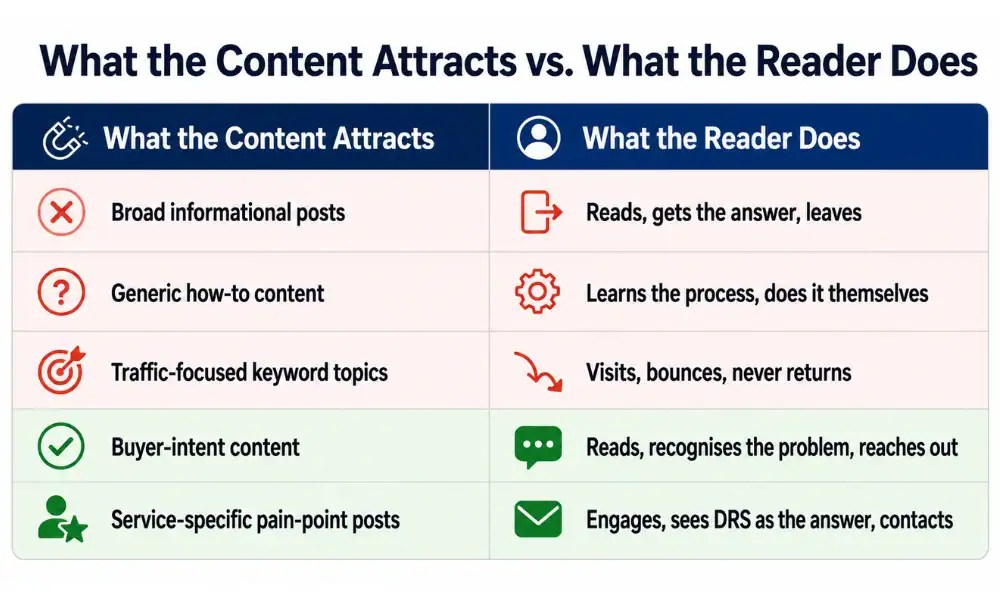
When a business owner or their content writer sits down to pick topics, the instinct is usually to answer things people are searching for. That is not wrong on its face. But the specific questions that get high search volume tend to be broad and informational — the kind of queries someone asks long before they have any intention of spending money. “What is content marketing” draws far more monthly searches than “content writing service for small business.” The first query produces traffic. The second produces buyers.
The gap between those two types of content is where most blog traffic leaks out. Readers who came looking for a definition or a general explanation get what they came for, and then they leave. They were not shopping. They were learning. And a blog full of that kind of content builds an audience of learners, not a pipeline of buyers.
Why blog traffic but no clients is an intent problem, not a volume problem
The instinct when traffic is not converting is to try to get more traffic. More posts, more keywords, more distribution. That impulse makes sense if the issue is reach. But when the issue is intent, more volume just means more of the same result.
Search intent is the reason behind a query. Someone searching “why does my website get traffic but no leads” is experiencing a problem and looking for someone who understands it. Someone searching “website traffic tips” is curious and browsing. Both groups end up on blog posts. Only one of them is likely to ever contact a business for help.
The instinct to publish more runs deeper than most owners realise. There is a whole separate problem for businesses that do produce volume but still see nothing move in search — writing more blog posts alone does not fix Google rankings, and the reasons why that happens are worth understanding alongside the intent issue.
This matters because Google itself has shifted heavily toward intent matching. According to Search Engine Journal’s guide to how people search, content that aligns with what a searcher actually wants to do, not just what they typed, performs measurably better in rankings and keeps visitors on page longer. A blog written for traffic quantity rather than decision-stage readers is fighting a battle it cannot win in either direction: it does not rank as well for the terms that matter, and the traffic it does pull in does not convert.
What Happens When a Blog Has No Connection to the Service You Sell
There is a second, quieter version of this problem. Some business blogs do cover relevant topics at the right intent level, but the content never connects clearly to the service the business offers. The reader finishes the post, understands the problem better, and then has no clear signal about what to do next or who can help.
This is where the blog becomes a library rather than a sales asset. A library is useful, but nobody calls the library for professional help. When content does not draw a clear line between the problem it describes and the service that solves it, readers leave informed but unconverted. They might remember the article was helpful. They probably will not remember what business published it.
The connection between what a post describes and what the business does has to be explicit. Not aggressive, not sales-heavy. But clear. A reader who finishes an article about why their content is not ranking should know exactly who they could call to fix that, and they should feel like reaching out is the natural next step, not a non-sequitur.
The Real Cost of Blog Traffic That Does Not Convert
Traffic without conversion is not just a wasted opportunity. It is an active drain on the business. Every blog post takes time and money to produce, whether that means paying a writer, spending hours researching and drafting it yourself, or both. If the output consistently brings in visitors who never become clients, that investment is buying you a readership you cannot monetize.
Over time, this produces a specific kind of discouragement. The business keeps publishing, keeps seeing traffic numbers that look reasonable, and keeps waiting for the pipeline to fill. When it does not, the conclusion that forms is that “blogging does not work.” That conclusion is understandable, but it diagnoses the wrong problem. The blog is working at attracting people. It is failing at attracting the right people for the right reasons.
The gap shows up clearly in how marketers measure success. HubSpot’s research on content marketing ROI found that 50% of businesses running a blog reported higher ROI from their content in 2024 than the year prior, and those are businesses with a content strategy aligned to buyer intent. Businesses publishing content for general interest traffic rarely show up in that category.
Why the Right Content Strategy Changes What the Blog Does for Your Business
Digital Ranking Solutions does exactly this kind of work. Their SEO content writing service handles keyword research, topic selection, and full article production, all built around the intent level that matters for each client’s specific service and audience. The posts they write are built to attract visitors who are already experiencing the problem the business solves, not general readers looking for information with no buying context. For businesses that have been publishing and watching the traffic numbers without seeing the client inquiries follow, that is the difference between a blog that looks busy and one that actually works. More at digitalrankingsolutions.com.
Traffic Is a Signal. Clients Are the Goal.
A blog that produces consistent visitors but no inquiries is telling you something specific: the content is reaching people, but not the right ones, or not at the right moment in their decision-making. That is a fixable problem, but the fix is not more posts. It is a different kind of post, built around what buyers search for when they are close to making a decision, not what curious readers search for when they are still just looking.
The businesses that get consistent clients from their blog did not stumble into it. They built a content strategy around what their buyers actually need to read before they reach out, and they made that content the centerpiece of what they publish. That is what separates a blog that generates traffic from one that generates business.
If your blog is producing traffic but not clients, the content is reaching the wrong people at the wrong moment. Contact Digital Ranking Solutions today for SEO content built around buyer intent, content that attracts the visitors your business actually needs.