
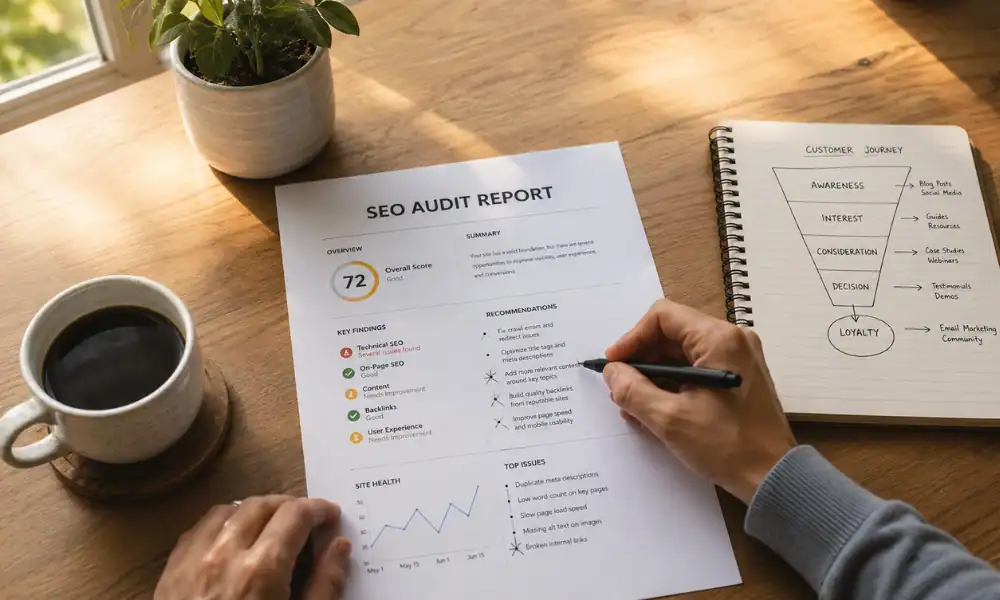
If you have been told your business needs SEO but nobody has clearly explained what that actually involves, what it costs in time and money, or whether it will work for a business your size, you are not alone. SEO for small businesses gets talked about constantly but explained poorly. This guide covers all of it: what SEO actually does, how it works, how long it takes, and what a small business with a real budget and real constraints should focus on first.
SEO for small businesses means making your website and content visible to the people already searching for what you sell. When it works, it brings in consistent organic traffic without paying for every click. Most small businesses start seeing early movement within three to six months and stronger, compounding results between six and twelve months.
What SEO Actually Does for a Small Business
SEO puts your business in front of people at the exact moment they are looking for what you offer. When someone searches “plumber near me” or “best accountant for small business,” they are not browsing. They are ready to hire. A business that shows up at the top of those results gets the call. A business buried on page three does not.
The difference between SEO and paid advertising is how long the results last. Ads stop the moment you stop paying. A well-ranked page keeps pulling in traffic for months or years after the initial work is done. That compounding quality is what makes SEO attractive for small businesses with limited budgets. You are building an asset, not renting visibility.
Organic traffic also converts at a higher rate than most other channels because the intent is already there. Someone who found your website by searching a specific question is further along in their decision than someone who saw a banner ad. That difference shows up in your inquiry rate, your call volume, and the quality of the leads you get.
The 5 Pillars of SEO for Small Businesses
SEO is not a single task. It is a combination of five areas that work together. Understanding what each one does helps you see why it takes time and why one piece alone rarely moves the needle on its own.
On-Page SEO
On-page SEO is everything you control directly on your website pages. Title tags, meta descriptions, heading structure, and how well your content matches what people are actually searching for. Google reads your pages the same way a reader would. It looks for clear signals about what the page covers, who it is for, and whether it actually answers the question. Pages that are well-structured with a clear keyword focus rank more consistently than pages with great design but weak underlying SEO.
Content and Blogging
Content is how small businesses build topical authority, the reputation Google develops for your site around specific subject areas. A business that consistently publishes well-written, useful blog posts about topics its customers care about builds credibility with Google over time. Each post is an additional entry point for organic traffic, and when posts are structured around a hub-and-spoke cluster model, they reinforce each other. Google rewards sites that go deep on a topic, not sites that publish random one-off articles with no connecting thread.
Local SEO
For most small businesses, local SEO is the highest-priority area. Local SEO is what determines whether your business shows up in Google Maps, the local three-pack, and searches that include a location. Your Google Business Profile is the center of local SEO strategy. Its completeness, the freshness of your posts and photos, and the volume of your reviews are all ranking signals Google uses to decide who appears in front of nearby searchers. A business with a fully optimized profile and a steady stream of genuine reviews will consistently outrank a competitor with a better-looking website but a neglected profile.
Technical SEO
Technical SEO covers the behind-the-scenes factors that affect how well Google can crawl and index your site. Page speed, mobile-friendliness, Core Web Vitals scores, proper URL structure, and clean site architecture all fall into this category. Most small business websites have at least a few technical issues that are quietly suppressing rankings. Slow load times and broken internal links are the most common. These are not glamorous fixes, but they matter. Google Search Central’s documentation on how Google crawls and indexes pages is the clearest reference for understanding what technical SEO actually involves at a foundational level.
Off-Page SEO and Backlinks
Off-page SEO is about your website’s authority in the eyes of Google, and the primary signal is backlinks. When another website links to yours, it functions as a vote of credibility. Not all links are equal. A link from a local chamber of commerce, a regional publication, or an industry directory carries more weight than a generic directory listing. Building backlinks takes time and usually requires creating content or earning coverage that other sites want to reference. It is the slowest part of SEO to build but one of the most durable once it is in place.
How Long Does SEO for Small Businesses Take?
Most small businesses start seeing early movement in three to six months, with stronger and more consistent results arriving between six and twelve months. That range is not a stall tactic. It reflects how Google actually works. Search engines do not hand out rankings quickly because they are evaluating trust signals that take time to accumulate: content depth, site history, backlink quality, and user behavior on your pages.
The timeline is faster for long-tail keywords in low-competition niches, and slower for broad, competitive terms in saturated markets. A local service business targeting a specific city will generally rank faster than a business trying to compete nationally against established players. New domains face the longest timelines because Google has no historical data to draw from.
One thing that consistently accelerates the process is publishing quality content on a regular schedule. Sites that publish two to four well-researched articles per month build topical authority faster than sites that publish sporadically. Consistency signals to Google that the site is actively maintained, which influences how often it gets crawled and how quickly new content gets indexed.
What slows things down: a technically broken site, thin or duplicate content, no internal linking structure, and no backlinks from credible sources. Fixing technical issues first gives everything else a better foundation to build on.
Why Small Businesses Can Compete in Google Search
The assumption that small businesses cannot compete with larger companies in search is wrong, and it is worth addressing directly. Google’s E-E-A-T framework evaluates four qualities in every piece of content: real-world experience, demonstrated subject knowledge, authority within a topic area, and trustworthiness. It actively rewards the kind of content that large brands and content farms struggle to produce: real, specific, experience-based writing that reflects genuine knowledge of a topic and a genuine relationship with a local market.
A small business owner who has spent fifteen years serving customers in a specific city has a distinct advantage over a national brand writing generic copy for a hundred markets at once. That practitioner-level detail, when it shows up in the content, is exactly what Google is trying to surface. The Search Engine Journal’s State of SEO 2026 report confirms that original content creation remains the top-performing tactic among SEO professionals, with two-thirds citing it as their strongest lever for sustained rankings.
The businesses that lose this competition are the ones publishing generic, templated content that could apply to any business anywhere. The businesses that win are the ones writing about their specific market, their specific clients, and the specific problems they solve every day.
SEO vs. Paid Ads: Where a Small Business Should Start
Paid ads and SEO are not competing strategies. They serve different purposes and different phases of business growth. That said, for a small business with a limited budget deciding where to put resources first, the case for SEO is straightforward.
Ads produce results immediately and stop the moment the budget runs out. Every click costs money, and in competitive markets, those costs are high. SEO takes longer to build but produces traffic that compounds over time. A blog post that ranks on page one for a relevant keyword in month six keeps pulling in leads in month twelve, month eighteen, and beyond, without additional spend.
The honest caveat is that SEO requires patience and consistent effort. Businesses that need leads immediately, such as a new business with no existing traffic or a business going through a slow period, often need paid ads to bridge the gap while SEO builds momentum. The most practical approach for most small businesses is to use paid search strategically for high-intent keywords while building organic traffic through content and on-page SEO at the same time.
The SEO for Small Businesses Starter Checklist
Before investing in advanced strategies, make sure these fundamentals are in place. Most of the businesses that see slow SEO results are missing at least a few of these:
- Google Business Profile fully completed with accurate name, address, phone, hours, photos, and service descriptions
- Website loads in under three seconds on mobile
- Each page targets one specific keyword, not three or four at once
- Title tags are 50-60 characters and contain the target keyword
- Meta descriptions are 150-160 characters and explain why someone should click
- At least one H2 heading on each page contains the target keyword
- Internal links connect related pages so Google can understand site structure
- At least one new piece of SEO-optimized content published per month
- Google Search Console connected and verified to monitor indexing and crawl issues
- NAP (name, address, phone) consistent across every directory and listing
None of these require a large budget. They do require attention to detail and the discipline to maintain them over time. A business that has all ten boxes ticked is in a much better position than a business spending money on advanced tactics without the foundation underneath.
What Digital Ranking Solutions Does With This
Digital Ranking Solutions works with small and mid-sized businesses that need SEO to actually produce leads, not just rankings. Their SEO content writing service handles keyword research, content strategy, and fully written, publish-ready blog posts built around the kind of topical authority clusters that build lasting Google visibility. For businesses that want to stop guessing and start building, it is a practical way to move forward without adding more to an already full plate. More at digitalrankingsolutions.com.
Where to Start When Everything Feels Overwhelming
SEO looks like a lot when you read a complete breakdown of it. In practice, most small businesses get results by doing a small number of things consistently well: keeping Google Business Profile current, publishing useful content on a regular schedule, making sure the technical health of the site is clean, and building a small number of quality backlinks over time.
The businesses that never see results from SEO are usually the ones that try to do everything at once, get overwhelmed, and stop. The businesses that win are the ones that pick a starting point, build a foundation, and stay consistent long enough for the results to compound.
If your website is not generating leads from search right now, the gap is almost certainly fixable. Contact Digital Ranking Solutions today and get a clear picture of what is holding your rankings back and what to do about it.