
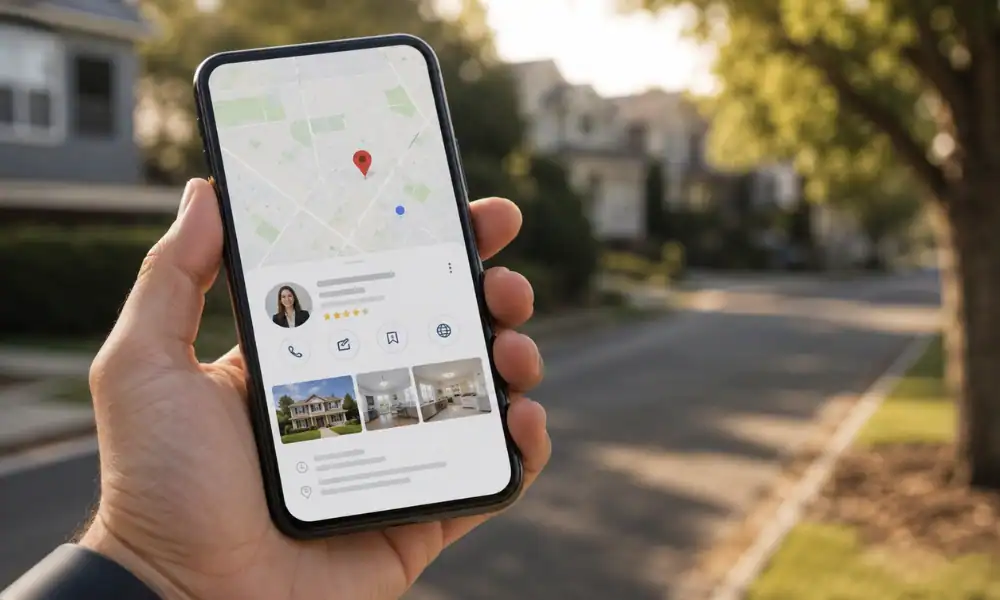
You might be the best agent in your market. But if a buyer searching “real estate agent near me” on their phone cannot find you, that matters very little. Local SEO for real estate agents is what controls whether your name appears in those searches: the ones happening right now, from buyers and sellers who are already in your market and ready to act. Most agents know they should be doing something about it. Far fewer understand what Google is actually checking when it decides which three agents show up in the local pack and which ones do not. This article explains the three local ranking factors, what each one requires, and how they work together as a system.
Local SEO for real estate agents is the process of building visibility in location-based Google searches. Google ranks agents in the local pack using three factors: relevance, proximity, and prominence. Relevance is how well your profile and content match the search. Proximity is how close your business is to the searcher. Prominence is how well-established and trusted your local presence appears across the web.
The Three Factors Google Uses to Rank Real Estate Agents Locally
Google’s local ranking system runs on three factors: relevance, proximity, and prominence. Understanding what each one means in practice is the starting point for any local SEO strategy that actually moves the needle.
Relevance is how well your Google Business Profile and website match what someone searched for. An agent who selected the correct business category, wrote a description naming the neighborhoods and client types they serve, and has website content that reflects those same specifics is highly relevant to a buyer searching in that area. An agent with a bare profile and a generic homepage is not. Relevance is largely within your control and is the fastest of the three factors to improve.
Proximity is how close your listed business location is to the person searching. This factor is the one agents have the least direct control over. Google factors in the physical distance between the searcher and the business address on the profile. An agent working primarily in a suburb will naturally rank more prominently for searches originating from that suburb than for searches from the city center. The practical implication: defining your service area accurately in your Google Business Profile matters, and publishing content that references the specific neighborhoods you serve gives Google additional proximity signals to work with beyond just the address.
Prominence is how well-established your business appears across the web. This includes the number and quality of Google reviews, the consistency of your business information across directories and platforms, the number of websites that reference or link to you, and the overall activity level of your Google Business Profile. Prominence takes the longest to build and compounds the most over time. An agent who has been collecting reviews consistently for two years and whose name appears correctly across fifty local directories will outrank a newer agent on this factor regardless of how well-optimized the newer profile is.
What Local Citations Are and Why They Affect Your Rankings
A local citation is any mention of your business name, address, and phone number on an external website. Every directory, real estate platform, social profile, and local business listing that references your details is a citation. The collective consistency of those citations across the web is one of the signals Google uses to assess how established and trustworthy a local business is.
The problem most agents have is not a lack of citations. It is inconsistent ones. A name that appears differently across platforms, “Jane Smith Realty” on one site and “Jane Smith Real Estate” on another, tells Google the information cannot be fully trusted. A phone number that changed two years ago and was never updated across directories creates the same problem. Small inconsistencies across many platforms add up to a measurable local ranking drag.
The fix is a citation audit: finding every place your business details appear online, correcting the inconsistencies, and removing duplicate listings. Tools like BrightLocal or a manual search of the major directories will surface most of the issues. According to Search Engine Journal’s guide to local SEO citations, consistent NAP data across authoritative directories remains one of the most reliable local ranking signals even as other factors evolve. Getting this right does not require ongoing effort once it is fixed. It is a one-time foundation repair that holds value indefinitely.
Local Content: The Ranking Signal Most Agents Skip
The local pack is dominated by Google Business Profile signals. But organic local search, meaning the results that appear below the map pack, runs on content. An agent who has built a library of neighborhood guides, local market updates, and location-specific buyer and seller guides will appear in far more searches than an agent whose website has five generic pages.
Local content works for two reasons. The first is that it builds topical authority around specific places. When Google sees an agent who has published detailed, original content about multiple neighborhoods in the same market over a sustained period, it reads that site as a genuine local resource rather than a placeholder. The second is that local content targets searches the national portals cannot win. Zillow and Realtor.com dominate broad searches, but a well-written neighborhood guide targeting “what it is like to live in [specific suburb]” or a market update targeting “[neighborhood] home prices Q2 2026” competes in a space where a local agent’s first-hand knowledge is a direct advantage.
This is where the Google Business Profile work and the content strategy connect. A post published on the site can be linked directly from a GBP post, creating a signal loop that reinforces both the profile’s activity and the site’s local relevance at the same time. Each piece of the local SEO system makes the others more effective when they are built to work together.
Digital Ranking Solutions has helped local businesses build the kind of sustained local presence that earns consistent rankings, not just a temporary spike after a profile update. For real estate agents who want to own their local market in search rather than rent visibility through paid ads, it is the kind of work that compounds in value over time. Learn more at digitalrankingsolutions.com/services/.
Building a Local SEO System That Holds
The agents who rank consistently in local search are not the ones who did the most work in a single month. They are the ones who built a system: an optimized profile, clean citation data, regular reviews, and a content library that keeps growing, and maintained it long enough for all three ranking factors to compound together.
Relevance gets you into contention. Proximity determines which nearby searches you are eligible for. Prominence decides whether you rank above the other agents who are also relevant and nearby. Getting all three working in the same direction, over the same sustained period, is what moves an agent from page two of the local pack to the top three spots that capture the majority of clicks.
Contact Digital Ranking Solutions today and get a local SEO strategy built to move your real estate business into the searches that matter most in your market.
AUTHOR BYLINE
Eric is the founder of Digital Ranking Solutions, a digital marketing agency helping small and mid-sized businesses rank higher, grow faster, and convert better. He works directly with clients on SEO strategy, content production, and web performance.
Frequently Asked Questions
Local SEO for real estate agents is the process of making your business visible in Google's location-based search results, including the local pack (the map results that appear at the top of the page) and organic results for searches that include a city or neighborhood name. It involves optimizing your Google Business Profile, building consistent citation data, collecting reviews, and publishing content that signals genuine local authority.
Google's local pack rankings are based on relevance, proximity, and prominence, not years in business or transaction volume. A competitor with a more complete Google Business Profile, more recent reviews, and cleaner citation data will outrank a more experienced agent who has not maintained those signals. Experience does not translate into rankings unless it is reflected in the digital signals Google can actually read.
Early movement in local pack rankings typically appears within two to four months of consistent work on the three core factors. Review velocity tends to show results fastest. Citation cleanup produces measurable improvements within six to eight weeks of completion. Content-driven local organic rankings take three to six months to build. The timeline compresses when all three areas are addressed at the same time rather than one at a time.
A Google Business Profile alone can rank in the local pack without a website, but a website significantly increases the range of searches you can appear in. The local pack captures buyers and sellers searching with location intent. A website with local content captures the larger volume of informational searches that happen before someone is ready to contact an agent. Agents with both tend to pull in leads at multiple stages of the decision process.
A local citation is any mention of your business name, address, and phone number on an external website, including directories, real estate platforms, and social profiles. Google cross-references these mentions to verify your business details are accurate and consistent. Inconsistent citations create a trust signal problem that quietly pulls down local rankings. Cleaning up citation inconsistencies is one of the fastest ways to recover lost local visibility.